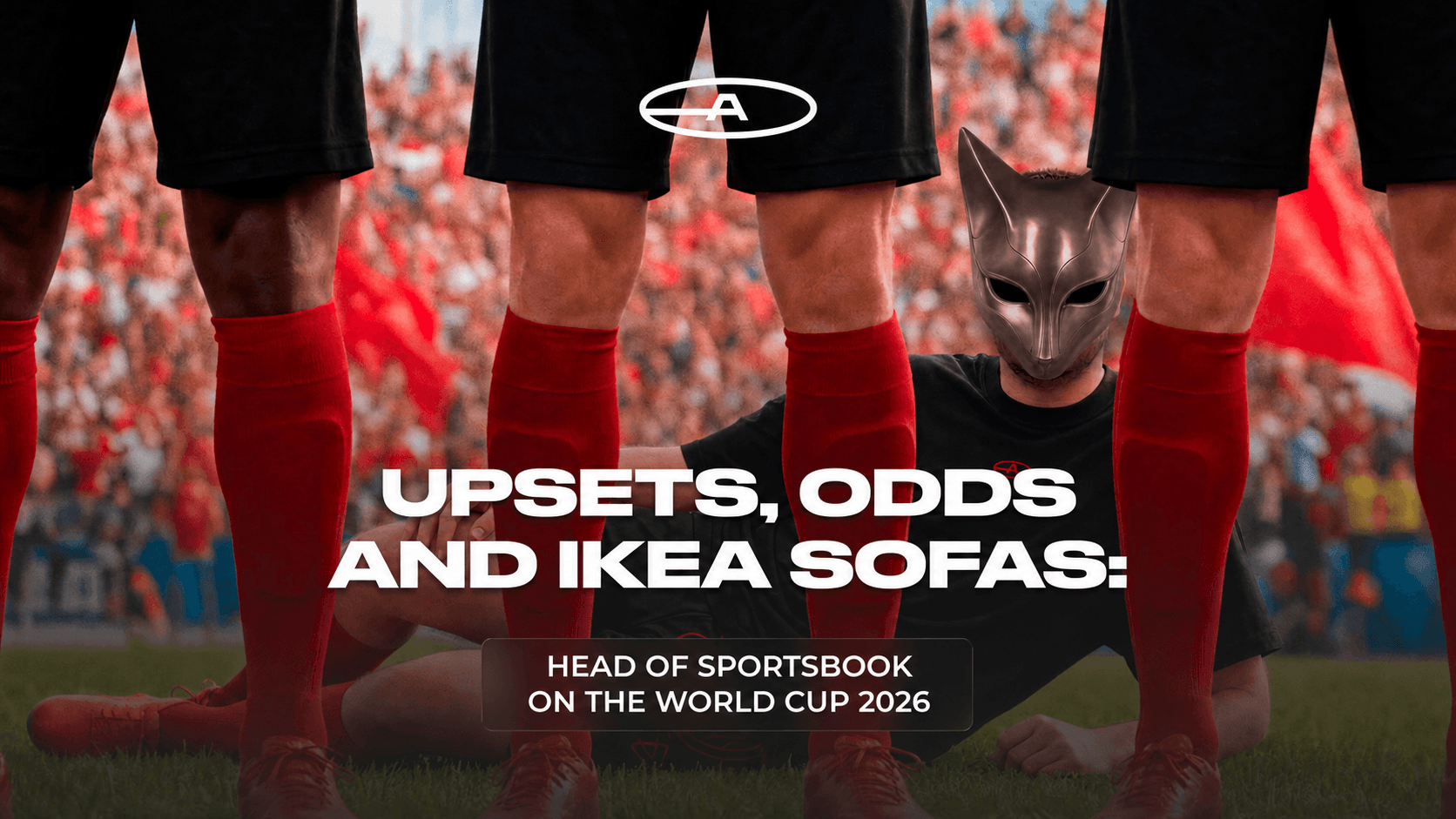
Upsets, Odds and IKEA Sofas: Head of Sportsbook on the World Cup 2026
The biggest World Cup in history just wrapped — and it earned the title. Where 2022 gave us 32 teams and 64 matches, 2026 stretched to 48 teams and 104 matches across three host nations, with a global audience FIFA puts north of six billion — the most-watched event football has ever staged. It was a tournament of goodbyes and arrivals in equal measure: Ronaldo and Modrić played their last World Cup, while Spain’s young generation — led by Lamine Yamal and Nico Williams — came of age on the biggest stage. And around all of it swirled more marketing, more brand noise, and more creator-driven attention than any tournament before.
We sat down with our Head of Sportsbook to talk about what the tournament looked like from the operator’s side — the upsets, the prep, the trends, and the marketing that actually broke through.
The biggest World Cup in history just wrapped. Before we get into the numbers — as someone who lives and breathes this — what was it like to watch it unfold from the sportsbook side?
For anyone who loves football — anyone who loves sport, really — this was a celebration. A flood of matches from day one, a farewell World Cup for several genuine legends, and, of course, betting volumes like nothing else on the calendar. From our side, it’s the one month of the year everything points toward.
And it all ended with Spain — a 1-0 win over Messi’s Argentina in extra time, their second title and the meanest defence the tournament has ever seen. As a fan first — what did you make of the final?
I actually enjoyed the third-place match more. Ten goals and completely open football — that always works in favour of the fans and everyone watching. As for the results, Spain had a brilliant tournament: their keeper conceded just one goal across every stage, they moved through the bracket with total control, and in the semi they shut France down and never gave them a sniff of a comeback. The final was more of the same — Spanish dominance, control of the ball, and they didn’t let Argentina get off a single shot in regulation. Messi deserved to be world champion two times running, especially after those comebacks in almost every knockout game, but it played out the way it played out — and to play football at that level at 38 is just unreal. All in all, the tournament delivered incredible emotions, favourites going down, results nobody saw coming, a flood of goals, and a real sense of celebration.
You called it “a tournament of upsets.” Which results caught you off guard — and with 48 teams and 104 matches, were more shocks almost inevitable?
The shocks started before the tournament even kicked off. Italy, four-time world champions, went out in the play-off qualifiers on penalties to Bosnia and Herzegovina. Then it just kept coming. Cape Verde didn’t lose a single game in regulation — in their opener against the reigning European champions they didn’t even concede, with the draw priced at 14. Germany were knocked out by Paraguay on penalties in the round of 16. Belgium were 2-0 down to Senegal until the 86th minute, levelled it in the 92nd, and won it in the 125th. Argentina came back from 0-2 to beat Egypt 3-2, then snatched it against England with goals in the 85th and 92nd. And yes — when you stretch the field to 48 teams and 104 matches, you’re building in more mismatches and more room for a Cinderella run. The surprises weren’t just luck; the format made them more likely.
Let’s clear something up — how much of the book does an operator like Alpha actually control? Walk us through where you really come in.
Quick myth-buster: we don’t set the odds ourselves. We work through platforms, who work with the providers, and the feed — the prices, the margins — comes to us from them. Where we come in is risk. With our risk team, we put a lot of work into limits, into the margins on individual markets, and into cashout settings. And the player behaviour this tournament was fascinating to watch. People cashed out the moment an underdog they’d backed scored. On the other side, we saw plenty of top-ups on the favourites in live, because the price only got better as the match went on. One favourites accumulator sticks in my mind — Brazil to beat Japan at 1.35 and Germany to get past Paraguay at 1.17, 1.58 combined. It lost. Which, for the operators on that feed, is exactly the result you want.
You prepared for this World Cup for four months. What does getting a betting operation ready for the biggest event in football actually involve?
Because we run a sportsbook across more than one brand, we started early. The first conversations were with the platforms — what they’d build on their side: a dedicated World Cup page, the markets, the widgets. Then every project got its own plan: pre-tournament campaigns and reactivations, the opening match, the group stage, the play-offs, the promo chains, the content calendar. After that, we presented the whole thing to every department involved — retention, acquisition, product, support, VIP — split the tasks, set the goals, locked the deadlines. Honestly, every team put in an enormous amount of work, and I’m grateful for it; everyone brought ideas and took initiative. If I had to sum it up: the projects were rebuilt from the ground up for the World Cup, from the visuals all the way to the mechanics.
More than 60% of bets are placed live now, with behaviour shifting to the moment — the next goal, the next event. Did this World Cup bear that out?
For us, live was well over 60% of all bets this World Cup. People wanted to follow the game and back the team they felt was about to turn it around, right there in the moment. The most popular pre-match bet was over on goals — and there were a lot of goals in most matches — while in live it was a team to qualify. Like I said, we saw plenty of top-ups on teams that ultimately didn’t win, and “salvation” bets too — will Belgium find a way past Senegal, that kind of thing.
Star players are often called the “atomic unit” of a modern bet — parlays and Bet Builders built around the big names. Did that trend play out this World Cup?
Honestly, I didn’t see a flood of player-stat betting. Sure, there were bets on the top names — Haaland, Messi, Mbappé, Kane, Ronaldo — and their individual numbers, but not across the board. Where it got interesting was the prediction markets around the players: best player of the match, one-on-one duels between specific players, even the offbeat stuff — like whether Ronaldo would shed a tear. That’s where the creativity was.
AI is now trading whole market lifecycles and predicting churn before it happens — at least on paper. Where’s it genuinely changing the work, and where’s it still hype?
I can’t speak for how colleagues use it, but for us AI is still a tool that helps — not a full-blown member of the team. I know plenty of operators build it into their systems: checking players for related-contingency betting, shifting margins minute by minute during a match, and more. It’s genuinely interesting to watch how the classic sportsbook changes as more AI gets baked in. But we’re not there yet, and I’d rather be honest about that than oversell it.
A World Cup floods you with first-time football bettors — but sport is notoriously hard to hold onto once the final whistle blows. What keeps that wave active?
Retention is always the interesting, difficult part. The whole industry is moving away from the bonus “arms race” toward a product that’s genuinely good and easy to use. On our side, we’ve already started prepping for the lull — there’s basically no football until mid-August. Straight after the World Cup we’re leaning into alternative sports beyond football, and virtual sports. And there’s cross-promo with casino, including gamification — missions to complete, rewards for completing them. The point is to give that new player somewhere to go once the tournament’s over.
Beyond the pitch — creators, memes, the whole online conversation. Where was the real attention this World Cup, and did brands keep up?
This World Cup was seriously creative. Haaland and Mbappé memes were everywhere, and the brands didn’t lag behind. Because a World Cup is a global event that pulls in people from every country, it was fascinating to see how companies from different places showed up. Airlines did collabs, sports and equipment brands leaned in, and the food and entertainment world wasn’t far behind.
If Alpha had an unlimited budget for one World Cup activation, what would you have done?
I’ve got a long list of ideas in my head, and I hope some of them happen one day. But if I had to pick one — probably an afterparty with the best players of the tournament, away from all the on-pitch rivalry, with a seriously good party lined up. 🙂
Which campaign this World Cup struck you as the most brilliant — the one that actually worked rather than just spending money?
I loved what IKEA did throughout the tournament. Plenty of creative campaigns, but one really got me. You’ve definitely seen it — the players who lie down behind the wall during a free kick. IKEA Saudi Arabia turned that into a sofa promo they called “Flat Out”: you’re watching a World Cup 2026 match, you spot a player lying under the wall, you screenshot it, send it to their Instagram, and get a discount on a sofa. The size of the discount equals the number on the player’s shirt. Simple, funny, and completely on-brand.
Betting brands are everywhere during a tournament like this. Who did it smartest, and where’s the line between clever and too much?
For any betting brand, the World Cup is the biggest event there is, so of course everyone pours huge resources into their campaigns. From the international operators, it was interesting to watch the giants — Stake, Polymarket (even if that’s technically a prediction market), Rubet and others. The main thing, though, is not to be too much for a potential new player, or you get the opposite effect.
Sport is one of the few things that genuinely unites people. How do the best campaigns tap into that, instead of just slapping a logo on it?
I’ve noticed a real trend toward authenticity and pride in where you’re from. We talked about how teams arrived in these incredible national outfits, showing off the style of their own culture. Beyond that, there are always socially important topics worth raising in front of a huge audience — and they land. Glitz and luxury don’t do much for me; but something that touches an ordinary person’s everyday life always earns my respect for the brand behind it.
This World Cup saw some real legends play their last tournament. What does a star’s “last dance” do for the game — and the fans?
It’s always sad when the players of your childhood, real legends, call it a day. I’ll admit I get a little emotional knowing these were the last matches for the likes of Neuer, Neymar, Modrić, Ronaldo. And you could see it’s hard for the players too. I think it’d be a lovely thing to give those farewells the send-off they deserve — whether you’re a fan, a teammate, or just someone who loves sport.
Controversial refereeing is part of every big tournament. From where you sit, how do disputed calls ripple through to the bettors?
Nobody’s perfect, and referees make mistakes. This tournament had a lot of moments most people felt should have gone the other way — penalties, red cards, obvious cards that never came. VAR helps, but as we saw, it isn’t always good for the game either. We had our share of disputed moments, and players came to us with questions. Our rule is simple: we go by the official sources, and if something genuinely went wrong — say a decision that’s changed after the match — we meet the player halfway.
Some of the biggest storylines were off the pitch. Which one shaped the conversation the most?
I’ve been in sport for 22 years, and what’s always interested me is the sport itself — not the private lives or the tabloids. If it’s about comparing sporting achievements, I’m always happy to hear every side and give my take. And of course, this tournament brought back the debate that’s been running for 15 years: Ronaldo or Messi. Ronaldo — a 41-year-old legend, the perfect athlete, as hard-working as they come. Messi — 38, a genius the game may never see again. For me, each of them is the best, in his own way, in his own place, with his own achievements. But the best, all the same.